


Every time we sit down with a new creative, we come away a little more inspired — and today's guest might be one of the most honest conversations we've had in a while.
Nat Purple describes herself as a mixed-media artist, graphic designer and illustrator, and honestly, no single label quite covers it. Her world is built from paper that's been folded, wire that's been bent, thread pulled through fabric, and film that's been scratched, drawn on and scanned back to life. It's a catalogue that includes gentle, everyday textures like On the Table and Soft Wrinkled Paper Textures, deeply personal collections like Not Tarot and Healing Collage Pack, and a full trend-driven sourcebook in MOODS & MUSES — and somehow none of it feels repetitive, because Nat never stops exploring new materials before she digitizes them.
We talked to her about starting from scratch, why she scans imperfections instead of erasing them, where AI fits (and doesn't) into her process, and how she'd actually build a finished design from her own packs, step by step. Grab a coffee — this one's worth reading slowly.

Starting from scratch
To start, we'd love for you to tell us a bit about yourself as a creator, for readers who might not be familiar with your work yet: how did you become a designer, what inspires you, and where do you find ideas for your pieces?
A few days ago, my daughter was drawing at the table, surrounded by paper, pencils, colors — everything she could possibly use. I told her how much I loved what she was doing and how beautifully she was choosing the colors. Then she asked me, “Did you do this when you were a child?”
And I said no. Because I really didn’t.
I didn’t grow up with many art materials, toys or much encouragement to explore creativity. The only creative thing I did was music. Her question made me stop and think about how impossible life is to predict — and how grateful I am that, many years later, creativity became such a large part of my life.
At some point, I simply felt that it was already somewhere inside me. I actually believe it exists in everyone in one form or another. I just began directing an enormous amount of attention toward it — and that attention gradually grew into the life and work I have now.
Today I would describe myself as a mixed-media artist, graphic designer and illustrator. I love drawing, creating collages and moving between different forms. If I discover a material or technique I haven’t tried before, I almost always want to see what I can do with it.
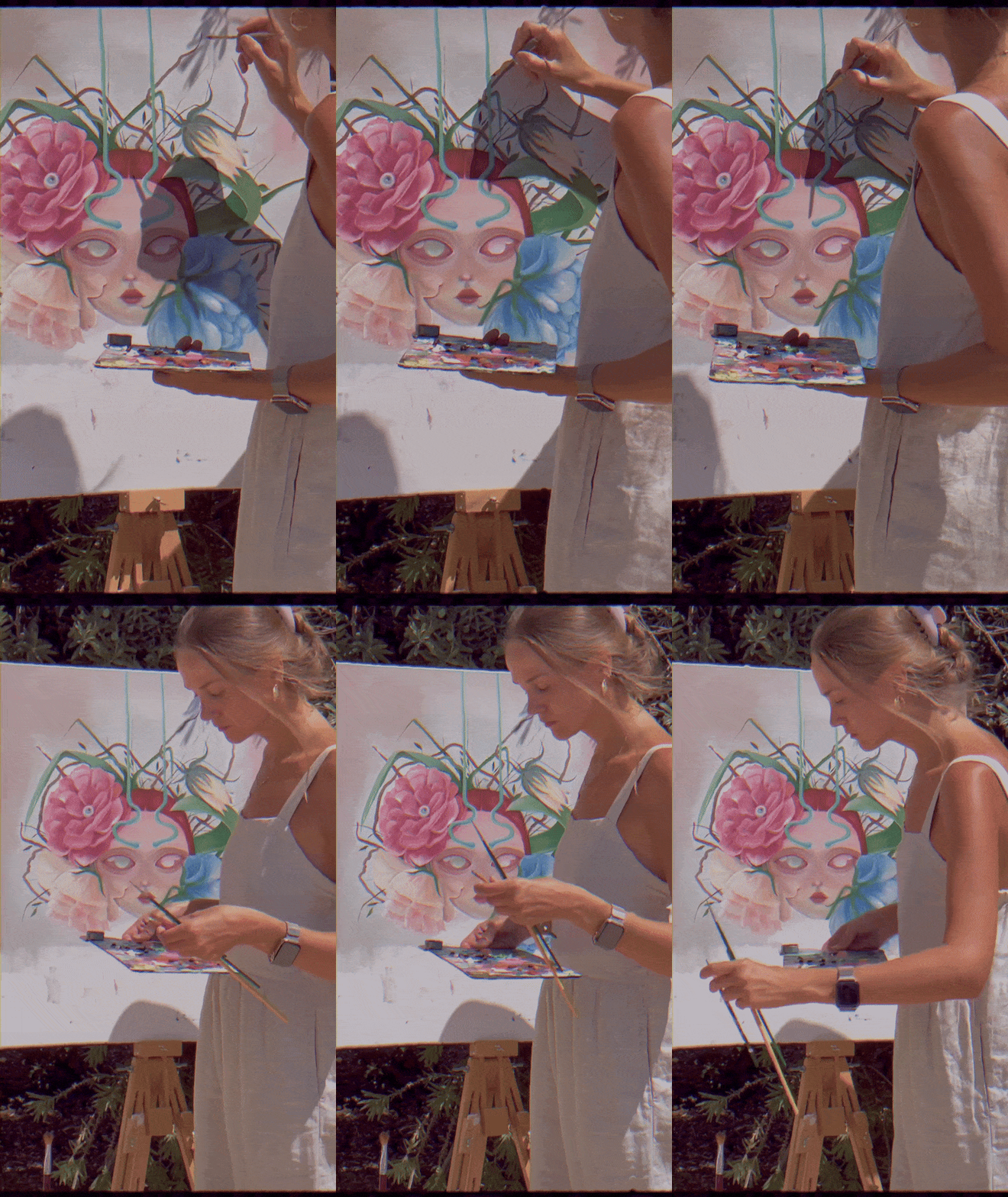
I don’t want to remain inside one recognizable method. The same thought can become a line drawing, a collage or something constructed from physical materials, and each version reveals a different side of it. The world is much too varied to explore in only one way.
Inspiration can come from almost anywhere. I can look at a sunset and notice the gradient moving from pink into blue. Or I can watch my daughter punching holes into a sheet of paper and suddenly see how bold and interesting it looks. For me, inspiration begins with paying attention.
Everything begins with touch
Your catalogue is almost entirely paper, collage and worn texture — On the Table, Soft Wrinkled Paper Textures, Laced. Where does a texture actually start for you: a scan of real paper, hand-painted marks you digitize or something built from scratch on screen?
Right now, everything begins with touch. I also see this return to physical materials as part of a wider shift: many people seem to be looking for something more tangible and human.
Over the past year or two, I’ve moved much further towards working with my hands. A new piece might begin with the feel of a sheet of paper, the resistance of wire as I bend it or the way dried flower petals change their colour and shape. I enjoy this stage enormously. It grounds me and gives me a very physical sense of being here, in the real world.
I think you can trace different periods of my life through my work: what I was feeling, what I was looking for, and how I was changing. Right now, I’m drawn to anything I can touch before I digitize it — paper, wire, felt, fabric, thread, or a hand-drawn line.
I recently borrowed an old sewing machine from my father-in-law, and I love working with it. There is something especially satisfying about making a new object with an old tool that already carries a history of its own.
Once the physical piece is finished, I scan it and bring it into a digital format. I make as few modifications as possible. Usually, I clean the scan, remove the background, and prepare the element for use in a collage. I want the digital version to remain close to the object that was lying on my table.

Preserving imperfection feels especially important to me now because I’m going through a period of wanting things to feel real. I spent quite a long time looking inward and moving towards surrealism. Perhaps I became a little tired of floating there. Now I find myself wanting to look at the world and see it as it is. Not every day, of course. But that is where I am at the moment.
Personal packs and trendbooks
You've released Not Tarot, Spirit Animals Oracle Cards, and Healing Collage Pack — themes most resource creators avoid because they're personal. Does a pack like that start from your own practice (journaling, pulling cards), or from noticing the audience wants that right now?
I still love these collections very much, although I wouldn’t make them in the same way now. Not because I consider the themes too personal, controversial, or somehow wrong. I simply don’t feel them as strongly anymore. Different things are happening inside me now.
You can probably trace what was happening in my life through everything I have created. I always begin with what genuinely interests me. I cannot make something simply because it is expected to sell, and I won’t work with a subject or material if I don’t recognize myself in it.
When I created these collections, I was going through a period of personal transformation.
Not Tarot in particular was both a great love and a great struggle. I worked on it for more than three months, abandoned it several times, and then returned to it again. I knew very little about tarot and had never done readings for myself. But I was in a mentally vulnerable place, and I wanted a deck that could offer support regardless of which card I picked.
I didn’t want traditional affirmations or relentlessly positive messages. If a card carried something difficult, I wanted to make it less frightening through humor and a little sarcasm. I researched the general meanings of tarot cards and then created my own interpretations as small emotional responses.
That is how cards such as Tears Are Power, End of Drama, and Waiting for Gold appeared.
Tears Are Power is a reminder that crying does not make us weak. Tears mean that we are alive, that we can still feel deeply, survive what we feel, and continue. There is strength in that — perhaps much more than in pretending that nothing can touch us.
End of Drama is a slightly impatient card. It says: enough now. Take a breath, pull yourself together, and step back into the light. The difficult part may have been real, but it doesn’t need to become your permanent role.
And then there is Waiting for Gold, with a skeleton quietly sitting and waiting. The joke is quite literal: we can spend our entire lives waiting for money, success, or the “right moment” to finally give us permission to be happy. We may wait until we are bones — and even then, none of that gold is coming with us.
Some cards offer a hand on the shoulder. Others give a small, friendly shake. I wanted both.

Spirit Animals Oracle Cards belong to the same period of my work, when I was especially interested in symbols and the meanings we attach to them.
Healing Collage Pack is still especially dear to me. Before it, I created a collection called Metamorphosis, built around five colors and five stages of moving through depression. After finishing it, I wanted to make something completely different: light, ethereal and entirely free from the emotional heaviness of the previous collection. I wanted people to look at it and immediately feel air, softness and relief.

I have never kept a journal, but perhaps my collections are my version of one. I translate my emotional states into images and materials.
Somehow, those private states often turn out to be collective ones. I live in the same world as everyone else. At the time, these collections became extremely popular, and I received very personal messages from people saying that finding one of them at a particular moment had helped them in some small way.
Today, they sell much less. Perhaps the larger mood has changed, or people have simply found a different visual language for expressing the same feelings.
I’m glad these collections exist. They preserve a real stage of my life and work, but I don’t need either myself or my audience to remain in that stage forever.
“Some cards offer a hand on the shoulder. Others give a small, friendly shake.”
MOODS & MUSES is a whole trendbook. Are you tracking what's coming from outside (Pinterest, runway, other creators), or mostly formalizing a direction your own collage work was already heading in?
MOODS & MUSES came quite directly from trend research. At the time, Pinterest had released its annual trend report, and I genuinely loved every direction that eventually made its way into the collection.
I wanted to turn those trends into a large, accessible visual sourcebook for designers. Instead of making several small collections around separate ideas, I brought everything together in one broad creative pack. It includes different formats and techniques, from watercolor to line art. I wanted it to feel generous but also flexible: designers could choose one direction, combine several, or take individual elements in a completely different direction.

This particular collection doesn’t have a deeply personal story behind it. I simply saw a group of trends that excited me and thought it would be useful — and fun — to translate them into one convenient creative toolkit for other designers.
Knowing when a theme is done
You've built 40+ products around one aesthetic world — faded color, vintage paper, collage — and none of them look like a repetition. Is there a rule you use for knowing when a theme (say, collage packs) is done, versus when it's worth one more variation?
I continue working with a theme for as long as I still feel a spark — while I’m enjoying it and can see a way to add something to what I have already made.
That distinction is important to me. If I can expand a subject, introduce another material, or reveal a side of it that wasn’t there before, I will continue. But if the only thing I can make is an alternative version of an existing collection — essentially my own substitute for it — I don’t see much reason to do that.
Right now, I know that I love working with paper, textiles, and almost any physical material I can get my hands on. But I don’t have a fixed system that tells me exactly when a theme begins or ends. My system, if it can be called one, is to listen to myself while also noticing what is happening around me.
I’ve learned that, for me, even the best systems remain useful only for a limited period. Whenever I create too many rigid principles or begin declaring that I work only in one technique, I slowly build a cage around my own creativity.
That is also why I would never say that I won’t return to an old subject. Perhaps next week I’ll suddenly want to create something esoteric again. If it feels exciting and honest at that moment, returning to it won’t mean that I have betrayed my current direction. I will simply be in a different place again.
Art, money and self-love
On your own website, you describe art as something that gives joy and "supports the soul". Does that idea survive once a piece becomes a commercial pack?
I would go further than saying that the original idea survives. I think it multiplies.
A work kept in a drawer is not less sincere or less valuable, but its movement ends with you. Once you release it into the world, other people can respond to it, reinterpret it, and carry some part of it into their own lives and projects. To me, that possibility also comes with responsibility.
Of course, I would love to create something meaningful and perhaps influence the world in some small way. But I also know how easily the desire to be important can become an exercise in ego. So I try to concentrate on making the work sincerely rather than imagining how significant it might one day become. The scale of its impact is not entirely mine to decide.
I’m inspired by people who communicate through art, cinema, books and other creative forms. The strongest work often begins with an idea, not a calculation. But the idea still needs time, materials, tools and sometimes other people’s paid work to become real. Artists also need stability, and if you have children, that stability includes creating a safe and comfortable life for them. The romantic idea that art should remain untouched by money has never felt honest to me. Creativity and money are not natural enemies. Money can give an idea the time and space it needs to exist. It can also allow the artist to keep working without turning every creative decision into a question of survival.
When I see one of my resources inside someone else’s project, I feel that something has returned to me through the exchange. Even when I never see the final result, the work supports me financially and gives me the freedom to continue creating with the same attention and care.
“Creativity and money are not natural enemies. Money can give an idea the time and space it needs to exist.”
There's a clear thread of self-love, self-growth, and healing running through your work. What drew you toward that direction in the first place?
I’m deeply grateful that I somehow found — and was found by — this way of creating and expressing myself.
Reflection and self-reflection are very important to me, and I love that I can practice them through my work. I can present a collection while also communicating an idea, a feeling, or something I have been trying to understand.
What first brought me toward this direction was simply life. I see creativity as a reflection of how we think and feel about life. Trends and cultural shifts are part of that reflection too, only on the scale of a whole society rather than a single person. They reveal something about what is moving through an entire society. I love observing that, feeling it and being part of it.
It is a slightly funny contradiction because I don’t particularly enjoy being in large crowds, but I do enjoy being among people. Creativity allows me to experience that connection without necessarily standing in the middle of the room.
The thread of self-love appeared in my work when I was still looking for that love, not when I had already found it. There was a period when I felt very low and believed that I was somehow undeserving of certain things. Through creativity, I was partly trying to convince myself that love and compassion should include me too — especially the compassion I was capable of offering myself.
The internal changes I was going through, along with the wider social crises happening around me, naturally entered the work. Experiences like these do not affect only the art; they change you, and the work inevitably changes with you.
Where AI fits (and doesn't)
Grain, warp, faded ink — the imperfection is the whole point of your work. Have you tried folding AI tools into any part of your process, even for early ideas, or is there a part of this craft you're sure it can't fake?
I’m quite calm about artificial intelligence. I use it, I find it useful, and I’m glad the tool exists.
It helps me with translations, captions, product information, keywords, research, and analysis. AI works extremely well when there is already a clear question, thoughtful input, and good source material. It can organize information, test conclusions, and help turn a messy amount of data into something useful. What I don’t use it for is the first creative impulse.
So far, AI has never given me the kind of idea that made me want to build an entire project around it. It can recombine references and suggest unexpected pairings, but it still needs someone to decide what deserves attention. It may help me answer a question, but it doesn’t give me the reason to care about that question in the first place.
“For me, the human part is not a particular texture or technique. It is attention, intention, and responsibility.”
I’m not interested in policing which tools other artists use. What matters to me is whether there is a conscious idea behind the work and whether the person making it takes responsibility for the result.
In my own products, the physical origin of the elements matters. I want the paper to have been folded, the thread to have passed through the fabric, and the marks on the film to have existed before they became digital files.
AI can already imitate grain, faded ink, and accidental-looking imperfections, and it will probably become even better at it. I don’t need to claim that there is one part of the craft it will never reproduce. That boundary will keep moving.
For me, the human part is not a particular texture or technique. It is attention, intention, and responsibility: noticing something, deciding that it matters, and choosing what to do with it.
No one knows exactly what AI will change or replace. I prefer to remain curious and continue making the work that feels honest to me.
What's next
Is there a new direction or format you're currently exploring or want to try next that we haven't seen from you yet?
At the moment, I’m trying to leave as much room as possible for experimentation. I’m especially interested in anything I can physically make with my hands. For example, there are tubes of white and silver dimensional paste lying on the table in front of me, and I keep thinking about what I could do with them. I also have a large pile of textile scraps and one particular idea for using them that I’m excited to test.
I’m experimenting with formats too. Recently, while making my MADE ON FILM textures, I began showing a little more of the process behind the finished collection. This project itself started with an accident. I had shot a roll of film, but after it was developed, I hung it up and realized that the entire roll was blank. Perhaps it hadn’t loaded into the camera properly — I still don’t know what happened. I took it as an invitation to experiment directly on the film.

I gathered whatever I could find around my studio: acrylic markers, embossing tools, brushes, pencils and pens. I drew, scratched and made marks directly on the negatives, then digitized them and turned the results into backgrounds and overlays.
That is roughly where I am now. I see a material, an accident or an object and begin wondering how it could become part of my work. I don’t always know the next format in advance. Usually, the material suggests it.
From pack to finished design
Could you walk us through how you'd apply a couple of your own packs to an actual design project — from picking elements to layering them into something finished? We'd love something both inspirational and genuinely practical our readers could follow.
A customer recently bought The Red Thread to use in a blog design, and I loved that idea. So I would use these collections to create a landing page that feels less like a polished web template and more like something assembled from photographs, paper, fabric, and thread.
I would begin with the background. I have a large collection of scanned papers and textiles, so I’d choose one quiet texture and use it as the physical surface of the entire page. Paper would make the design feel more archival and personal, while fabric would connect it to the embroidery. I would keep the contrast subtle enough for the text to remain clear — the background should be felt before it is consciously noticed.

Next, I would choose the main photograph. The image needs to carry the page before you add any decoration. I’d place it inside one of the embroidered frames from The Red Thread: Stitched Collage. That would become the central element of the hero section and establish the visual direction for everything that follows.
To make the photograph feel less clean and digital, I might add an overlay from BAD SCAN for a rougher analog quality. For a softer result, I could instead choose one of my wrinkled-paper or pearl-texture overlays. The important thing is to use one effect rather than stacking everything at once.
For the written sections, I would bring in Stitched in Red Elements. One embroidered letter could become a large initial at the beginning of an article or introduction. I stitched and scanned the entire alphabet while preserving the tiny holes made by the needle. When the PNG is placed over paper or fabric, the letter looks as though it has been sewn directly into that particular surface rather than pasted on top of it.
At this stage, the page would still feel relatively editorial. To make it more intimate and less magazine-like, I would add one small composition from Paper & Layers: a translucent envelope containing a piece of paper with a handwritten note. I’d let the paper sit slightly unevenly and overlap the envelope naturally. It could hold a quotation, a date, a link, or a short personal message — something that feels discovered.
I would repeat the red thread only a few times: in the main frame, in the initial letter, and perhaps in one small detail further down the page. The paper or fabric background would hold all these elements together, while the red thread would guide the eye through the layout.
My main advice is to give the elements a hierarchy. One piece should lead, a few should support it, and the rest can stay inside the folder. A good collection offers many possibilities, but a good composition doesn’t need to demonstrate all of them.
Not every artist can tell you exactly why a piece works. Nat can, and still leaves room for the accident that started it all. Explore her full collection of paper, collage, and mixed-media resources.

A graphic design blogger passionate about good product design and typography. Alina keeps up with design trends and seeks the choicest toolbox ideas for creative specialists.